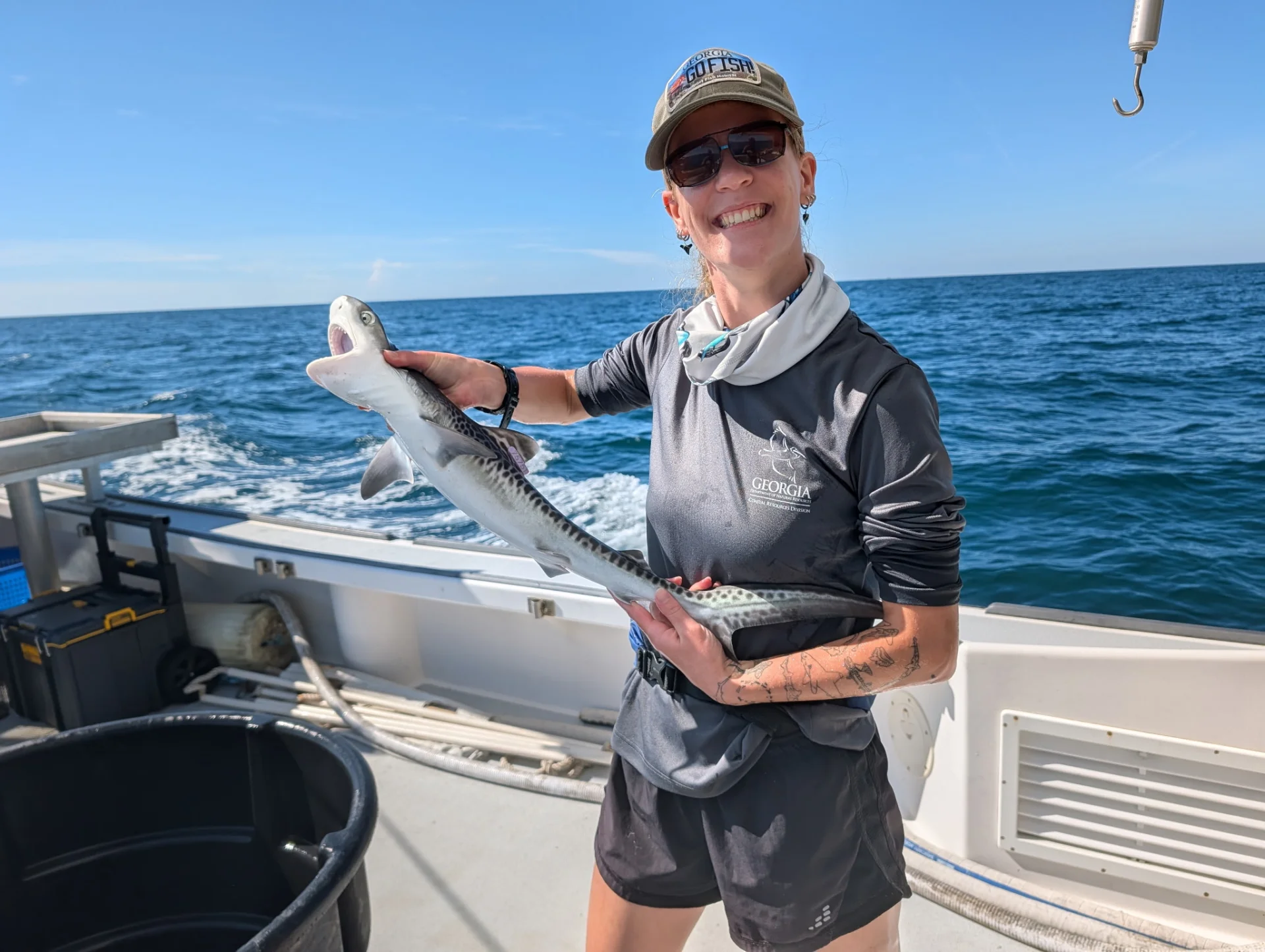
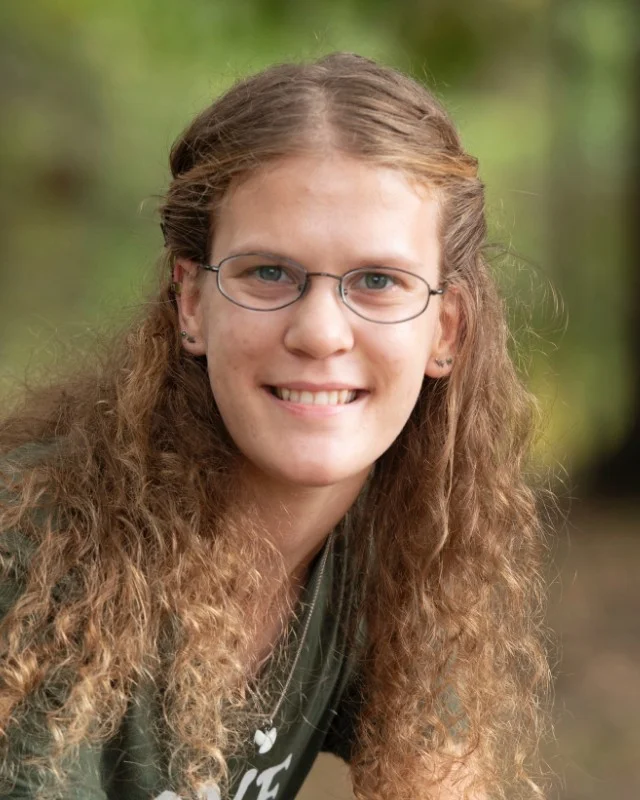
Elizabeth Williamson, 2022
August 21st, 2026


Tagging Sharks Along Georgia's Coast
From mummifying chickens in Middle School to tagging sharks off Georgia's coast, Riverfield alum Elizabeth Williamson turned a lifelong fascination with marine life into a career in fisheries research and conservation.
Tell us about yourself and what you're doing now. My name is Elizabeth, but many call me Lizzie or Liz. I have been in love with sharks for just about as long as I can remember. My love of sharks is usually what people remember about me, and I have been told many times that when others see sharks, they often think of me. I have just graduated from college with a B.S in Marine Science and a B.S. in Sustainability, Geography, and Environmental Planning, as well as minors in Public Policy and GIS, and certificates in Research and Service Learning. Right now, I am working with the Georgia DNR Coastal Resources Division on their shark longline project.
What is one lesson, experience, or mentor from Riverfield that has stayed with you? One experience that I am sure to never forget was when we mummified chickens in middle school. We were working up carcasses one day, and my coworker made a remark about how awful the smell was after we came back from lunch, and the carcasses had been sitting out in the heat. I agreed, but told her it was not the worst thing I had ever smelled, and told her about the time my class mummified chickens in middle school when we were learning about the Egyptians. We used coffee grounds to cover the smell, but that only worked for about a day, then it smelled like coffee grounds and rotting chicken. I sometimes get a whiff of rotting chicken when I smell coffee grounds to this day.
How did your time at Riverfield help prepare you for where you are today? My senior year at RCDS, the juniors and seniors got to do a weeklong internship in a field they were hoping to go into. I got to do my internship with the ODWC (Oklahoma Department of Wildlife Conservation). That experience opened the door for me to work as an actual intern the summer after my freshman year of college, providing field sampling and fish identification skills, which I believe helped me get the job I have now, as well as broaden the career field I wanted to go into. Rather than have my focus solely on sharks, I learned that I also really like other kinds of fish, and one career option for me would be working in a state-level fish and wildlife department.
Tell us about your role with the Georgia Department of Natural Resources and the Marine Fisheries Section Longline Project. I work in the Coastal Resources Division, specifically the Fisheries Section. We go out quarterly to set longlines to collect data on what sharks are where. We collect data on species, sex, maturity, size, and weight. We tag all sharks we bring up except the Atlantic Sharpnose (Rhizoprionodon terraenovae). This gives us an idea of the shark demographic of the area, and the tagging tells us if and when we recapture a shark. 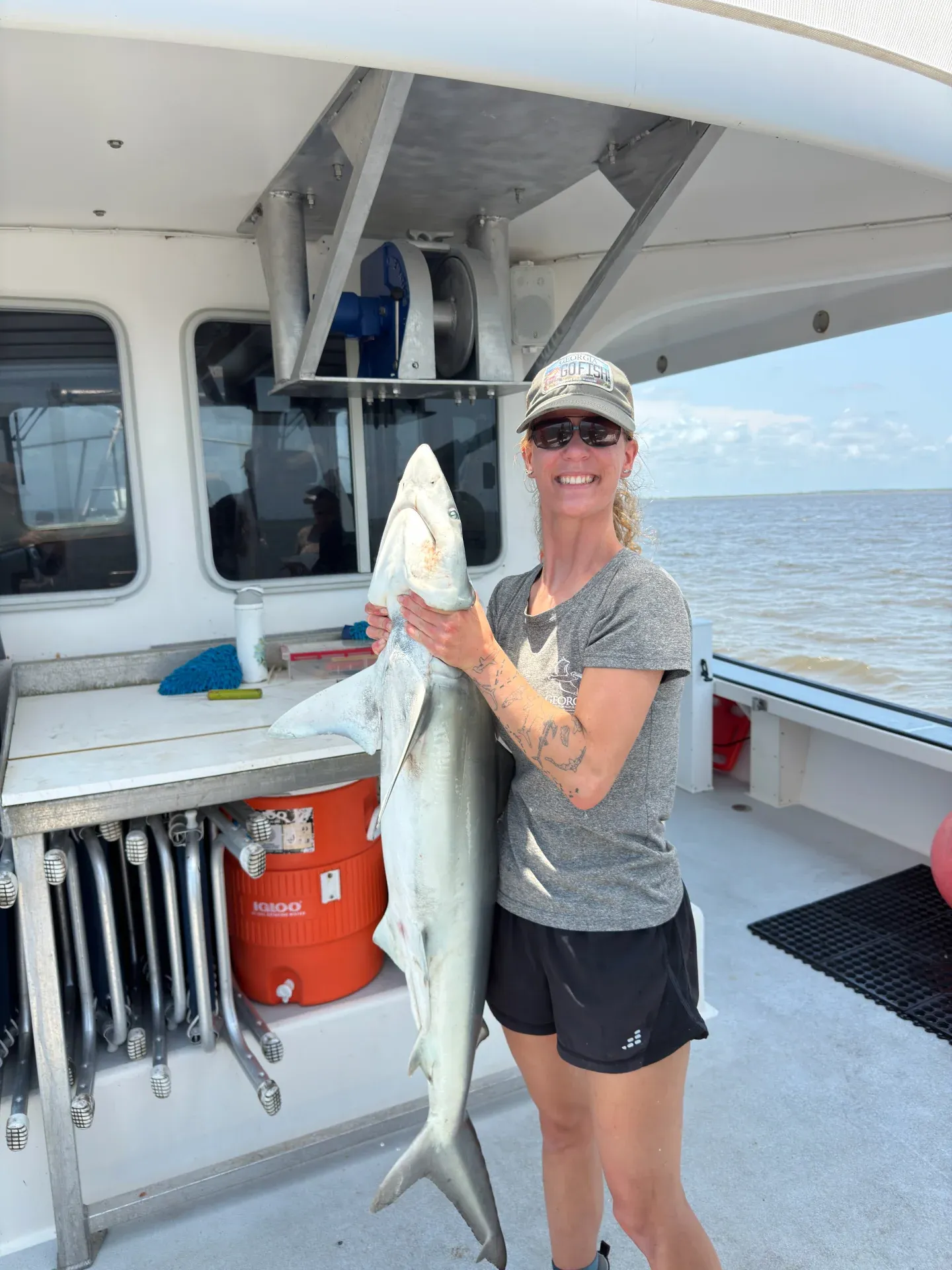
What does a typical day in the field look like when you're surveying and collecting data on sharks? There are two other seasonal hourly workers on the project with me. We try to prep the boat the Monday before we go out, filling up ice chests, cutting bait, and ensuring we have all the gear we need. When we arrive at a site, we have already baited the hooks and decided on our roles and how we will rotate through the roles throughout the day. There is a setter, a handler, and an extra hand. The setter sets the anchors, hooks, and buoys on the line while our supervisor operates the winch, spooling the line out. The handler hands hooks to the setters while the extra hand takes the hooks off the board to give to the handler. Once the line is set, we collect environmental data, such as wind speed and direction, air and water temperature, dissolved oxygen, and salinity. We fill a pool on the boat with water to act as a holding area for sharks we pull up if they cannot be worked up right away. To haul in the line, the person who set the line takes the hooks and anything attached to the hooks off the line while the winch reels the line in. The handler from setting the line is in charge of working up the sharks that come up, while the extra hand rebaits hooks that come up empty or helps out with the sharks if necessary. Once the line is in and all the sharks are back in the water, we go to our next site and do it all over again, switching up our roles. When we get back to the office, we clean up the boat and prep for the next day.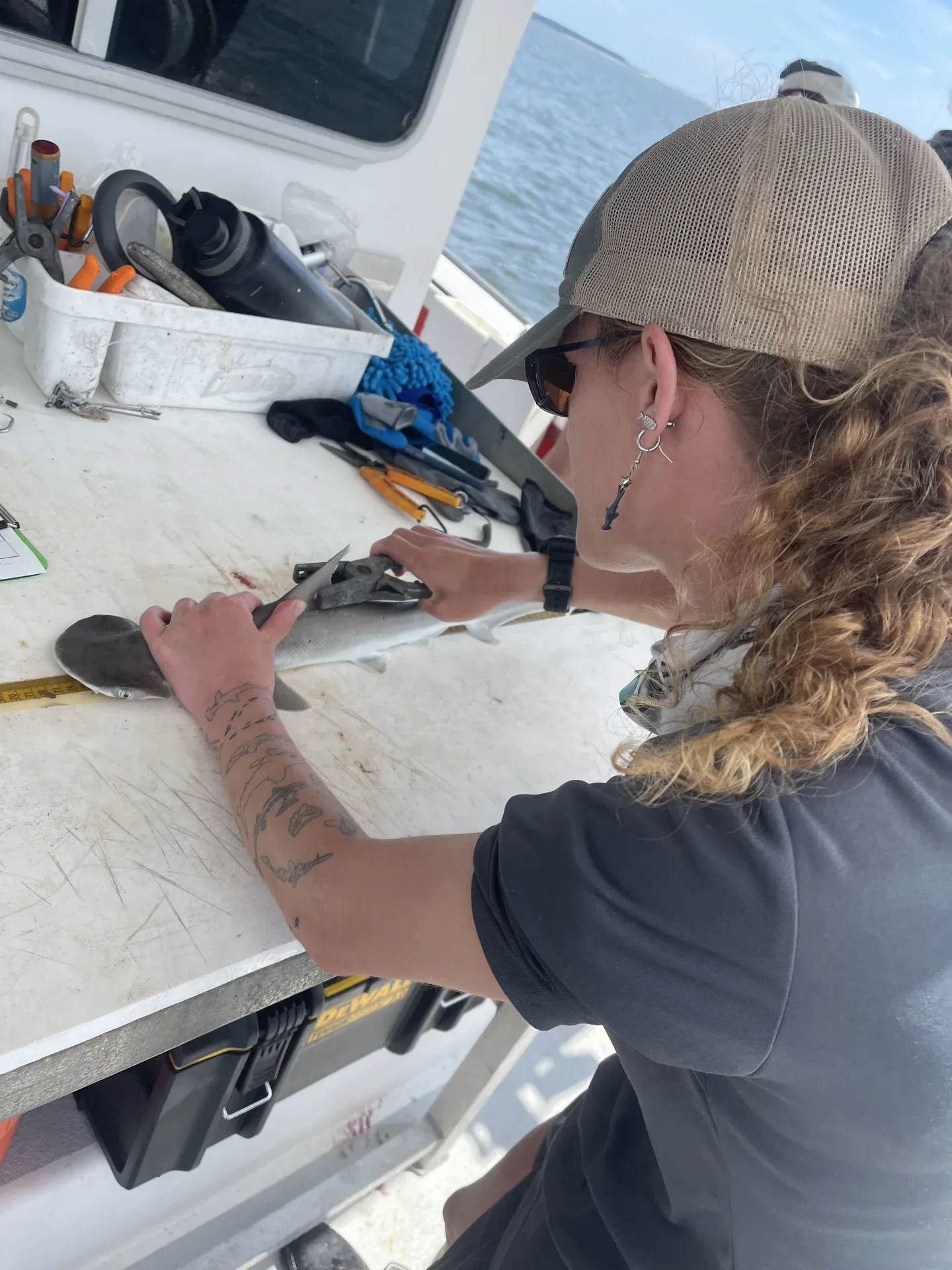
What inspired you to pursue a career in marine science and fisheries research? I fell in love with sharks when I was in kindergarten. I saw a picture of a shark on the cover of a book at the book fair, and I thought it was the cutest creature I had ever seen. From there, my love, curiosity, and passion for sharks grew, and I knew that working with sharks was what I wanted to do in life; I just wasn’t sure how to get there or what that job would look like. After my time at the ODWC, I learned how much I liked working with fish, and fishery work was a career option I was open to.
What's the most interesting or unexpected thing you've learned from working with sharks? The most unexpected thing I’ve learned from working with sharks is how heavy they are. They look small, but they are pure muscle, and when said muscle is angry, pulling them up onto the boat can prove a bit of a challenge.
Why is shark research and conservation important, and what do you hope people will better understand about these animals? Research (ideally) leads to understanding, and understanding helps us learn the best way to help conserve a species. Conservation is important because every species on this planet plays a role in the environment. The research and conservation of sharks helps with keeping the oceans healthy. Sharks not only keep prey populations in check but can serve as indicator species, their presence or lack thereof, displaying the health of an ecosystem. I hope people understand that sharks are not cold-blooded killers, nor are they a nuisance. Sharks belong in the ocean, and they have an important role to play.
What has been your proudest professional accomplishment so far? My proudest professional accomplishment is either tagging a shark or submitting a paper to a peer-reviewed scientific journal to hopefully be published.
What advice would you give current Riverfield students as they think about their future? Don’t limit yourself to one narrow idea of what you want to do. Be open to changing your mind or pivoting because there is more than one path you can take to reach a goal. I did not know what college I wanted to go to until my senior year of high school, and I did not know where I would end up or what I was going to do once I graduated from college until the spring semester of my senior year. I only ended up at the GA DNR because I took a job working the beaches in St. Augustine, making sure they were ready for sea turtle nesting season. I kept asking God what I was doing there, as I had no idea, or how the experience was going to benefit my long-term goal, yet it was because of that job that I learned about the position I have now. My supervisor used to work at the GA DNR on a different project and knew of the shark long lining gig, and gave me the contact information for my current supervisor. Bottom line: don’t limit yourself to a narrow goal, and network in any position you have - you never know how one experience or person can set you down a path you didn’t even know was there.
Lightning Round!
- Coffee or tea? - Tea
- Sunrise or sunset? - Sunset
- Favorite shark species? -VERY hard to choose, either Salmon shark (Lamna ditropis) or Basking shark (Cetorhinus maximus)
- Favorite place you've visited for work? – The St. Mary’s River between Florida and Georgia. The scenery was beautiful.
- One piece of field gear you can't live without? – a YSI
- Favorite animal besides sharks? - Ray-finned fishes (Actinopterygii), specifically the smallmouth buffalo (Ictiobus bubalus)
- Dream travel destination? - Kelp forest or Ireland
- Three words that describe your job. – Dream come true
- Favorite Riverfield tradition or event. - Campout
- Best advice you've ever received. - You can network and turn any experience into a valuable skill and learning opportunity. Everyone starts somewhere.